The Day Pocahontas Married an Englishman, the Day the Rosenbergs Were Sentenced to Death — April 5 in World History
In 1242, the fate of Russia was decided on a frozen lake. In 1614, a Native American princess married an English colonist in the New World. April 5 has witnessed wars and weddings, economic upheavals and Cold War shadows — moments that quietly reshaped the course of civilization.
🌍 Today in World History — TOP 5
1. The Battle on the Ice — Alexander Nevsky's Triumph (1242)

Background — In the early 13th century, Eastern Europe faced a dual threat: the Mongol invasion from the east and the aggressive expansion of the Teutonic Knights from the west. The German crusading order had conquered the Baltic region and was pushing deeper into Russian territory. Alexander Nevsky, the young prince of Novgorod, had already proven himself by defeating Swedish forces at the Battle of the Neva in 1240.
What Happened — On April 5, 1242, the forces of Novgorod clashed with the Teutonic Knights on the frozen surface of Lake Peipus, along the modern Estonian-Russian border. Nevsky deliberately weakened his center to lure the knights' feared "wedge formation" into a trap. As the heavily armored crusaders charged forward, Russian cavalry swept in from both flanks in a devastating pincer movement. The ice reportedly cracked under the weight of the armored knights, plunging many into the freezing water. The Teutonic Order suffered a catastrophic defeat.
Significance — The "Battle on the Ice" halted the Teutonic Knights' eastward expansion and established Nevsky as one of Russia's greatest military heroes. The battle was immortalized in Sergei Eisenstein's 1938 film Alexander Nevsky, with a stirring score by Prokofiev. During World War II, the Soviet Union invoked this medieval victory as a symbol of Russian resistance against German aggression — a parallel that resonated powerfully across centuries.
2. Pocahontas Marries John Rolfe (1614)

Background — In 1607, England established Jamestown, its first permanent settlement in North America. Relations between the colonists and the powerful Powhatan Confederacy were fraught with tension, alternating between trade and armed conflict. Pocahontas, born around 1596 as the daughter of Chief Powhatan, had already entered colonial legend through the famous (and likely embellished) story of saving Captain John Smith's life. In 1613, English colonists kidnapped her as a bargaining chip.
What Happened — During her captivity, Pocahontas converted to Christianity and was baptized as "Rebecca." On April 5, 1614, she married tobacco planter John Rolfe in a ceremony at Jamestown. The marriage was a strategic alliance that served both sides: Chief Powhatan wanted his daughter's release, while the English desperately needed peace to develop their tobacco economy. The union ushered in the "Peace of Pocahontas," roughly eight years of relative calm between the colonists and Native Americans.
Significance — The marriage of Pocahontas and John Rolfe is one of the most iconic moments in early American history, symbolizing the complex — and often tragic — encounter between European colonizers and Indigenous peoples. While Disney romanticized the story, the reality was far darker: a young woman married under duress while being held captive. Pocahontas traveled to England in 1616 as a celebrity but died there in 1617, aged just 21, likely from pneumonia or tuberculosis.
3. FDR Signs Executive Order 6102 — Banning Private Gold (1933)
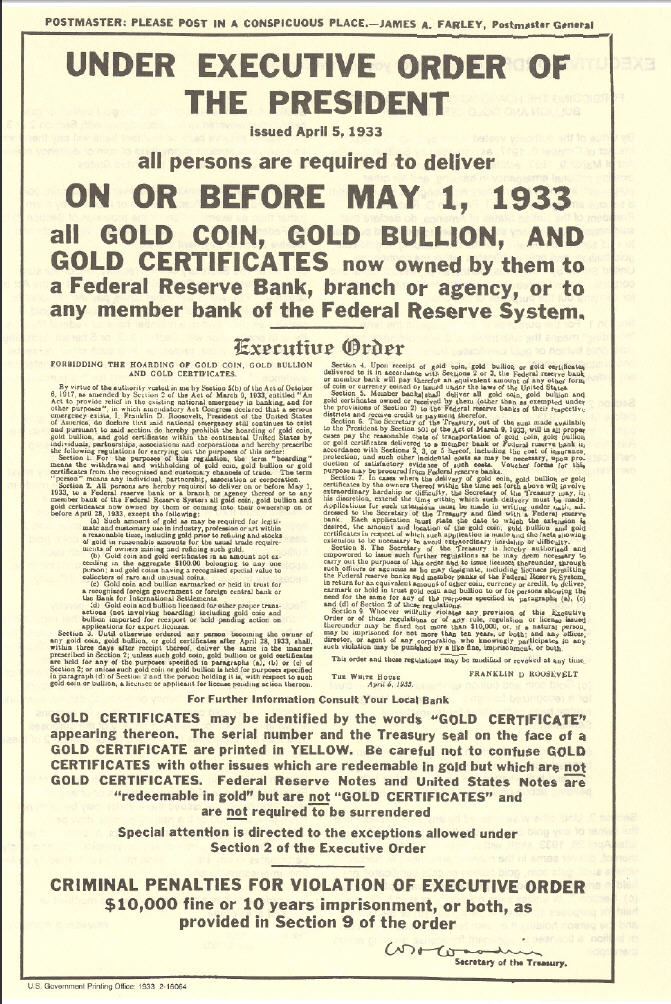
Background — By 1933, the United States was in the depths of the Great Depression. Unemployment had soared to 25%, over 9,000 banks had failed, and GDP had contracted by nearly 30%. President Franklin D. Roosevelt, inaugurated just weeks earlier on March 4, needed to expand the money supply to fight deflation. But under the gold standard, the Federal Reserve's ability to print money was constrained by its gold reserves.
What Happened — On April 5, 1933, Roosevelt signed Executive Order 6102, which made it illegal for American citizens to hoard gold coins, gold bullion, and gold certificates. All gold had to be surrendered to the Federal Reserve by May 1 at a fixed price of $20.67 per ounce. Violators faced fines of up to $10,000 (equivalent to roughly $230,000 today) or up to 10 years in prison. That same day, Roosevelt also signed Executive Order 6101, establishing the Civilian Conservation Corps (CCC), which put 250,000 young men to work in national forests and parks.
Significance — Executive Order 6102 was the first step toward abandoning the gold standard entirely. Once the government had collected private gold, it revalued gold to $35 per ounce — effectively devaluing the dollar by 40% to boost exports and combat deflation. The order remains one of the most controversial executive actions in American history, frequently cited by cryptocurrency advocates and libertarians as proof that governments can and will confiscate private wealth. The gold standard was not fully abandoned until Nixon's 1971 decision.
4. The Rosenbergs Sentenced to Death — Cold War Sacrifice (1951)

Background — When the Soviet Union successfully tested an atomic bomb in August 1949 — years earlier than Western intelligence had predicted — shockwaves rippled through American society. Someone must have leaked nuclear secrets. McCarthyism was gripping the nation, and the FBI launched a relentless hunt for Soviet spies. The trail began with Klaus Fuchs, a British physicist who had worked on the Manhattan Project, and led to David Greenglass, a machinist at Los Alamos — and ultimately to his sister Ethel and her husband Julius Rosenberg.
What Happened — On April 5, 1951, Judge Irving Kaufman sentenced Julius and Ethel Rosenberg to death for conspiracy to commit espionage — specifically, for passing atomic bomb secrets to the Soviet Union. The sentence was unprecedented: no American civilian had ever been executed for espionage during peacetime. The key witness was Ethel's own brother, David Greenglass, who testified that Julius had recruited him and that Ethel had typed up stolen documents. A worldwide clemency campaign erupted, with figures from Albert Einstein to Pope Pius XII appealing for mercy. On June 19, 1953, both were executed by electric chair at Sing Sing prison.
Significance — The Rosenberg case remains the defining espionage drama of the Cold War. Declassified Soviet cables (the Venona project) later confirmed that Julius was indeed a Soviet spy who passed valuable military secrets. However, the same evidence revealed that Ethel's involvement was minimal at best. In 2001, David Greenglass admitted he had lied about Ethel's role to protect his own wife. In 2023, the New York City Council passed a resolution declaring that Ethel Rosenberg's execution was unjust — a belated acknowledgment 70 years in the making.
5. The Tiananmen Incident — China's April Fifth Movement (1976)
Background — When Premier Zhou Enlai died on January 8, 1976, the Chinese people lost the one leader many viewed as a voice of reason during the chaos of the Cultural Revolution. Zhou had protected intellectuals, maintained diplomatic channels, and quietly opposed the radical excesses of Mao Zedong's wife, Jiang Qing, and her allies — the so-called "Gang of Four." As the Qingming Festival (a traditional day for honoring the dead) approached in April, the Gang of Four attempted to suppress public mourning for Zhou and used the moment to attack their political rival, Deng Xiaoping.
What Happened — On April 5, 1976, hundreds of thousands of Beijing citizens gathered at Tiananmen Square to honor Zhou Enlai. They laid wreaths, wrote poems, and delivered speeches at the Monument to the People's Heroes — many of which were thinly veiled attacks on Mao and the Gang of Four. By nightfall, the authorities moved in. Militia and public security forces forcibly cleared the square, and hundreds of people were arrested. Mao declared the gathering a "counter-revolutionary incident" and stripped Deng Xiaoping of all his positions.
Significance — The "April Fifth Movement" was the first mass expression of public dissent against the Cultural Revolution. Just five months later, Mao died on September 9, 1976, and the Gang of Four was arrested in October. The April 5 protests were officially rehabilitated as a "revolutionary act," and Deng Xiaoping was restored to power, launching the era of Reform and Opening Up that transformed China into a global economic powerhouse. This earlier Tiananmen incident is often overshadowed by the more famous 1989 protests, but it was arguably the more consequential turning point in modern Chinese history.
📌 History is a mirror reflecting today. Learning from past mistakes and drawing inspiration from great achievements — that's why we study history. What historical events await you tomorrow?
Comments
Post a Comment