The Night the Lumière Brothers Lit Up a Screen, the Day Dachau's Gates First Opened — March 22 in World History
In 1895, a flickering beam of light in a Parisian auditorium gave birth to cinema. On the same date in 1933, a barbed-wire compound near Munich opened its gates to become the blueprint for industrialized horror. March 22 carries the full weight of human contradiction — our capacity for breathtaking creation and unfathomable cruelty, separated only by the turning of calendar pages.
🌍 Today in World History — TOP 5
1. The Lumière Brothers Screen the First Motion Picture (1895)
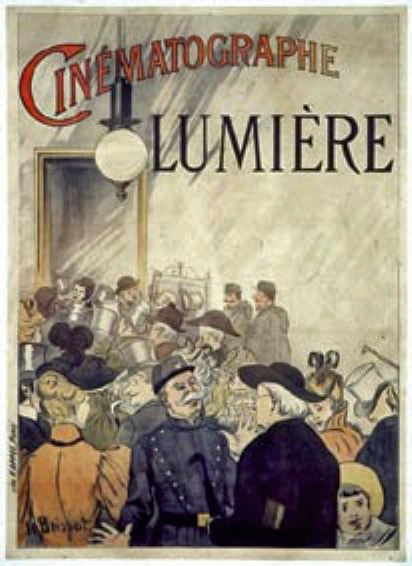
Background: By the early 1890s, the race to capture and reproduce moving images was heating up across Europe and America. Thomas Edison had invented the Kinetoscope in 1891 — a peephole device that allowed one person at a time to watch short loops of film. But the dream of projecting moving images onto a screen for an audience remained unrealized. In Lyon, France, Auguste and Louis Lumière — sons of a photographic plate manufacturer — were working on a device that could shoot, develop, and project film using a single, portable machine they called the Cinématographe.
What Happened: On March 22, 1895, the Lumière brothers held their first demonstration before the Société d'Encouragement pour l'Industrie Nationale in Paris. The audience watched a 46-second film titled La Sortie de l'usine Lumière à Lyon (Workers Leaving the Lumière Factory), showing employees streaming out of the Lumière factory gates at the end of a workday. The film was shot at 16 frames per second. Later that year, on December 28, the brothers held their famous first public paid screening at the Grand Café in Paris, showing ten short films to 33 paying customers.
Significance: This March demonstration marked the birth of cinema as a medium. What began as a 46-second recording of workers leaving a factory spawned a global industry now worth over $100 billion annually. The Lumières themselves famously dismissed their invention as "a novelty without a future" — perhaps the most spectacularly wrong prediction in entertainment history. Every film ever screened, from Casablanca to Avatar, traces its lineage to this day.
2. Nazi Germany Opens Dachau — The First Concentration Camp (1933)

Background: Adolf Hitler had been Chancellor of Germany for less than two months. On February 27, the Reichstag fire gave the Nazis the pretext to suspend civil liberties through the Reichstag Fire Decree. With political opponents — communists, social democrats, trade unionists — now subject to arrest without trial, the regime needed facilities to hold them. Heinrich Himmler, then Munich's police president, identified a disused munitions factory in Dachau, a small town 16 kilometers northwest of Munich.
What Happened: On March 22, 1933, Dachau concentration camp officially opened under Himmler's orders. The first inmates were approximately 200 political prisoners. The camp's iron gate bore the cruelly ironic inscription "Arbeit macht frei" (Work sets you free). Dachau became the prototype for all subsequent Nazi concentration camps — its organizational structure, guard training system, and methods of prisoner control were replicated across the expanding network. By the time U.S. forces liberated the camp on April 29, 1945, over 200,000 prisoners had passed through its gates, and at least 41,500 had died from execution, starvation, disease, and forced labor.
Significance: Dachau was the starting point of the Holocaust's machinery of death. What began as detention for political dissidents metastasized into a continent-spanning system that murdered over six million Jews and millions of others. Pastor Martin Niemöller's famous warning — "First they came for the communists, and I did not speak out" — was rooted in this precise moment. Dachau stands as a permanent reminder that the erosion of rights, once begun, can accelerate beyond anyone's worst imagining.
3. The Beatles Release Their Debut Album 'Please Please Me' (1963)
Background: By early 1963, four young men from Liverpool were setting Britain's music charts on fire. Their singles "Love Me Do" and "Please Please Me" had climbed the charts, and Beatlemania was taking shape. Producer George Martin, sensing the moment, wanted an album out as quickly as possible. But studio time was scarce, and the solution was audacious: record the entire album in a single day.
What Happened: On February 11, 1963, the Beatles entered EMI Studios on Abbey Road for a marathon recording session that lasted approximately 10 hours — from 10 AM to 10:45 PM. Excluding the four tracks already released as singles, they recorded ten new songs in that single session. John Lennon was battling a severe cold, but his raw, throat-shredding vocal on the final track, "Twist and Shout," became one of the album's defining moments. The album Please Please Me was released on March 22, 1963. It shot to number one on the UK album chart, where it remained for 30 consecutive weeks — only to be replaced by the Beatles' own second album, With the Beatles.
Significance: Please Please Me is widely regarded as one of the most important debut albums in popular music history. It launched the "British Invasion" that would reshape American and global popular culture. The album's raw energy, captured in a single marathon session, proved that rock and roll didn't need polish — it needed authenticity. The Beatles went on to become the best-selling music act of all time, with estimated sales exceeding 600 million units worldwide. It all started with this album, recorded in one extraordinary day.
4. Britain Passes the Stamp Act — Igniting the American Revolution (1765)

Background: Britain had just emerged victorious from the Seven Years' War (1756–1763), defeating France and securing dominance over North America. But victory came at a staggering cost. The national debt had nearly doubled to £130 million, and maintaining 10,000 British troops in the colonies required £350,000 annually. Prime Minister George Grenville believed the colonists — the primary beneficiaries of the military protection — should help shoulder the financial burden.
What Happened: On March 22, 1765, the British Parliament passed the Stamp Act, the first direct tax imposed by Britain on its American colonies. The law required colonists to purchase specially stamped paper for every legal document, newspaper, pamphlet, almanac, and deck of playing cards. Revenue was expected to cover roughly one-third of the cost of maintaining the colonial military garrison. The colonial reaction was explosive. Under the rallying cry "No taxation without representation," merchants organized boycotts of British goods, mobs burned stamp distributors in effigy, and the Sons of Liberty formed to coordinate resistance. The Stamp Act Congress, meeting in New York in October, declared that only colonial legislatures could impose taxes on colonists.
Significance: Although Parliament repealed the Stamp Act in March 1766, the damage was irreversible. The principle at stake — whether a distant parliament could tax people who had no representation in it — became the defining question of the revolutionary era. The Stamp Act set in motion a chain of events leading to the Boston Tea Party (1773), the First Continental Congress (1774), and the American Revolutionary War (1775). A tax on paper ultimately gave birth to a nation founded on the principle that government derives its authority from the consent of the governed.
5. Cosmonaut Valeri Polyakov Returns After 438 Days in Space (1995)
Background: The Space Race was over, but Russia continued to push the boundaries of long-duration spaceflight. The Mir space station, launched in 1986, served as humanity's primary laboratory for studying the effects of extended weightlessness on the human body. Dr. Valeri Polyakov, a physician-cosmonaut, volunteered for an unprecedented mission: to spend more than a year continuously in orbit, serving as both the subject and the observer of a long-duration experiment directly relevant to future crewed missions to Mars.
What Happened: Polyakov arrived at Mir aboard Soyuz TM-18 on January 8, 1994. For the next 437 days, 17 hours, and 58 minutes, he orbited Earth approximately 7,075 times, covering roughly 300 million kilometers — farther than the distance from Earth to Mars. He conducted extensive medical self-monitoring, tracking changes in bone density, muscle mass, cardiovascular function, and psychological well-being. On March 22, 1995, Polyakov returned to Earth aboard Soyuz TM-20. In a remarkable display of physical resilience, he walked unaided from the landing capsule — while most long-duration astronauts require assistance or stretchers after far shorter stays.
Significance: Polyakov's 438-day record remains unbroken as of 2026 — over three decades later. His mission provided critical evidence that humans can physically endure the roughly 6-to-9-month journey to Mars. The medical data he collected continues to inform planning for NASA's Artemis program and future Mars missions. If humanity one day sets foot on the Red Planet, that achievement will rest partly on the foundation laid by one physician-cosmonaut who spent 438 days looking at Earth through a porthole window.
📌 History is a mirror reflecting today. Learning from past mistakes and drawing inspiration from great achievements — that's why we study history. What historical events await you tomorrow?
Comments
Post a Comment