The Day Gorbachev Became the Soviet Union's Last Leader, the Day a 9.0 Earthquake Shattered Japan — March 11 in World History
In 1985, a 54-year-old reformer ascended to the Kremlin's highest seat of power. In 2011, on the same date, the earth shook for six agonizing minutes and swallowed more than 19,000 lives. March 11 is the day that foreshadowed the fall of an empire and exposed just how fragile human civilization is before nature's merciless force.
🌍 This Day in World History — TOP 5
1. Verdi's Opera 'Rigoletto' Premieres in Venice (1851)
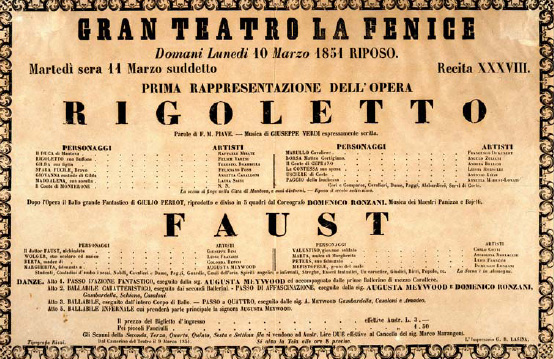
On March 11, 1851, Giuseppe Verdi's opera Rigoletto debuted at La Fenice Theatre in Venice. Based on Victor Hugo's play Le roi s'amuse (The King Amuses Himself), the work was born under the watchful eye of Austrian censors. The original was nearly banned for satirizing monarchy, but Verdi salvaged it by relocating the setting from the French court to the Duchy of Mantua.
The tragedy of the hunchbacked jester Rigoletto — who inadvertently causes his own daughter Gilda's death — gave the world "La donna è mobile," one of the most recognizable arias ever composed. On opening night, the audience erupted in applause, and by the next morning, gondoliers throughout Venice were already humming the melody.
Rigoletto marked the beginning of Verdi's acclaimed middle trilogy (alongside Il Trovatore and La Traviata) and represented a turning point when Italian opera evolved from mere entertainment into profound psychological drama. Over 170 years later, it remains one of the most frequently performed operas worldwide.
2. The United States Signs the Lend-Lease Act (1941)
On March 11, 1941, President Franklin D. Roosevelt signed the Lend-Lease Act into law. At the time, the United States had not yet entered World War II, but Britain was fighting Nazi Germany virtually alone while enduring the devastating Blitz. Britain's dollar reserves had run dry — it simply could not afford to purchase the weapons and supplies it desperately needed.
Roosevelt employed a brilliant metaphor to circumvent isolationist sentiment: "If your neighbor's house is on fire, you don't haggle over the price of your garden hose — you just lend it." Even the bill number was symbolic — H.R. 1776, evoking the year of American independence. The House passed it 260–165, and the Senate 60–31.
Through Lend-Lease, the U.S. ultimately shipped $50.1 billion worth of supplies (equivalent to roughly $690 billion today) to Allied nations: $31.4 billion to Britain, $11.3 billion to the Soviet Union, $3.2 billion to France, and $1.6 billion to China. The act transformed America into the "Arsenal of Democracy" and laid the groundwork for the U.S.-led international order that would define the postwar era.
3. Mikhail Gorbachev Becomes Soviet Communist Party General Secretary (1985)

On March 11, 1985, 54-year-old Mikhail Gorbachev was elected General Secretary of the Communist Party of the Soviet Union. In the preceding three years, the USSR had lost three leaders in rapid succession: Brezhnev (died 1982), Andropov (died 1984), and Chernenko (died March 10, 1985 — just one day before). Exhausted by a gerontocracy averaging over 70 years of age, the Politburo chose its youngest candidate.
Gorbachev immediately introduced two defining concepts: glasnost (openness) and perestroika (restructuring). He sought to revive the stagnant Soviet economy and allow suppressed freedoms of expression. Through a series of summits with President Reagan, he eased Cold War tensions and signed the Intermediate-Range Nuclear Forces (INF) Treaty in 1987.
But the wave of reform exceeded even Gorbachev's own expectations. Eastern European satellite states toppled their communist governments one after another. The Berlin Wall fell in 1989, and by 1991, the Soviet Union itself dissolved. Gorbachev entered history as the USSR's last leader — and as the central figure in ending the Cold War.
4. Lithuania Declares Independence from the Soviet Union (1990)
On March 11, 1990, the Lithuanian Supreme Council adopted the "Act of the Re-Establishment of the State of Lithuania," declaring independence from the Soviet Union. The vote was decisive: 124 in favor, 0 against, with 6 abstentions. Lithuania thus became the first Soviet republic to declare its withdrawal from the USSR.
Lithuania's independence movement had gained momentum through the Sąjūdis movement starting in 1988, exploiting the political opening created by Gorbachev's glasnost. On August 23, 1989, roughly two million people joined hands to form the "Baltic Way" — a 600-kilometer human chain stretching from Tallinn (Estonia) through Riga (Latvia) to Vilnius (Lithuania), capturing the world's attention.
Moscow refused to recognize Lithuanian independence. It imposed an economic blockade, and in January 1991, Soviet troops stormed the Vilnius TV tower, killing 14 civilians in a tragic assault. Yet Lithuania held firm. After the failed Soviet hardliner coup in August 1991, international recognition finally came. Lithuania's bold declaration of independence proved to be the fuse that ignited the dissolution of the Soviet Union.
5. The Great East Japan Earthquake — Magnitude 9.0 and Fukushima (2011)

At 2:46 PM JST on March 11, 2011, a magnitude 9.0 undersea megathrust earthquake struck 130 km east of Sendai in the Pacific Ocean. It was the most powerful earthquake ever recorded in Japan's history and the fourth strongest worldwide since modern seismography began in 1900. The quake lasted six excruciating minutes, and the resulting tsunami reached a staggering height of 40.5 meters at Miyako, Iwate Prefecture. Near Sendai, the wave traveled at 700 km/h and penetrated up to 10 km inland.
Official figures report 19,759 deaths, 6,242 injuries, and 2,553 people missing. Sendai residents had only 8–10 minutes of warning, and more than 100 evacuation sites were washed away. Snowfall and freezing temperatures that accompanied the tsunami further hampered rescue operations.
The catastrophe did not end there. The tsunami knocked out the cooling systems at the Fukushima Daiichi Nuclear Power Plant, causing three reactors to undergo meltdown. It was only the second nuclear accident in history rated at Level 7 on the International Nuclear Event Scale, alongside Chernobyl. Hundreds of thousands of residents within a 20 km radius were evacuated, and economic damage reached $360 billion — making it the costliest natural disaster in recorded history. Japan remembers this day simply as "3.11."
📌 History is a mirror reflecting today. Learning from past mistakes and drawing inspiration from great achievements — that's why we study history. What historical events await you tomorrow?
Comments
Post a Comment