The Day the Eiffel Tower Pierced the Paris Sky, the Day the Warsaw Pact Vanished into History — March 31 in World History
In 1889 Paris, a 300-meter iron tower pushed the limits of human imagination skyward. In 1991, the military alliance that had propped up the Cold War quietly signed its own dissolution. March 31 is a day where the defining moments of world history converge.
🌍 This Day in World History — TOP 5
1. 1889 — The Eiffel Tower Becomes the World's Tallest Structure

Background: Ahead of the 1889 Paris World's Fair, the French government launched a competition for a monument to serve as the exhibition's centerpiece. The team led by engineer Gustave Eiffel won the bid, but the announcement sparked fierce opposition from Parisians and intellectuals alike. Writer Guy de Maupassant, composer Charles Gounod, and some 300 other prominent figures signed a petition calling the proposed tower "a disgrace to the city's beauty." Eiffel pressed on regardless, and construction took two years and two months to complete.
What Happened: On March 31, 1889, the Eiffel Tower was officially completed. Eiffel himself climbed all 1,710 steps to the summit, carrying a French tricolor flag which he planted at the very top. Standing 300 meters tall (324 meters with its antenna), it was the tallest man-made structure in the world at the time. A total of 18,038 iron pieces and 2.5 million rivets were used in its construction — and remarkably, not a single worker died during the build. Approximately two million visitors flocked to the tower during the World's Fair.
Significance: Originally slated for demolition after 20 years, the Eiffel Tower was saved by its usefulness as a radio transmission antenna and went on to become the eternal symbol of Paris. To date, it has welcomed over 300 million visitors. The tower stands as a testament to Industrial Age engineering and remains one of history's most fascinating examples of fierce opposition transforming into universal adoration.
2. 1492 — The Alhambra Decree: Spain Expels Its Jewish Population
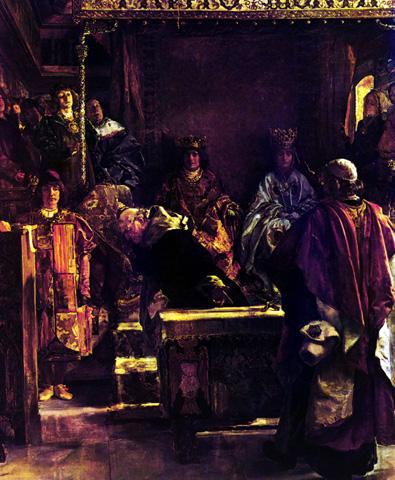
Background: In 1492, King Ferdinand II and Queen Isabella I of Spain conquered Granada, the last Muslim stronghold on the Iberian Peninsula, completing the centuries-long Reconquista. The Catholic Monarchs sought religious unity across their realms and had already established the Spanish Inquisition in 1478 to monitor conversos — Jews who had converted to Christianity.
What Happened: On March 31, 1492, Ferdinand and Isabella signed the Alhambra Decree at the Alhambra Palace in Granada. The edict ordered all Jews in Spain to convert to Christianity or leave the country within four months. An estimated 200,000 Jews were forced into exile, scattering across Portugal, North Africa, and the Ottoman Empire. Those who fled became known as the Sephardi Jews and went on to develop their own distinctive cultural traditions, including the Ladino language.
Significance: The Alhambra Decree stands as one of the largest acts of religious persecution in European history. Spain lost many of its finest scholars, physicians, merchants, and financiers — a brain drain that dealt lasting damage to the country's economy and intellectual life. The decree was not formally revoked until 1968, and in 2015, Spain passed a law granting citizenship to descendants of expelled Sephardi Jews as a gesture of historical reconciliation.
3. 1959 — The Dalai Lama Crosses into India as a Political Exile

Background: Since the Chinese People's Liberation Army invaded Tibet in 1950, the 14th Dalai Lama, Tenzin Gyatso, had attempted to coexist with the Chinese government. But on March 10, 1959, a massive popular uprising erupted in Lhasa. When the Chinese military moved to crush the revolt and intelligence reports warned of an imminent artillery attack on the Dalai Lama's Norbulingka summer palace, the 23-year-old spiritual leader made the agonizing decision to flee.
What Happened: Disguised and accompanied by attendants and a small guard, the Dalai Lama slipped out of Lhasa and began a harrowing trek across the Himalayas. After roughly two weeks on foot through some of the world's most treacherous mountain terrain, the Dalai Lama and his party crossed into Indian territory on March 31, 1959. Indian Prime Minister Jawaharlal Nehru granted him political asylum, and the Dalai Lama established the Tibetan government-in-exile in Dharamsala, northern India. Around 80,000 Tibetans followed him into exile.
Significance: The Dalai Lama's exile opened a new chapter in the Tibetan independence movement. Through nonviolent resistance, he earned worldwide support and was awarded the Nobel Peace Prize in 1989. Over more than six decades in exile, he has championed Tibetan cultural preservation and religious freedom. The events of 1959 remain an unresolved flashpoint in international politics, continuing to shape relations between China, India, and the broader international community.
4. 1991 — The Warsaw Pact Dissolves: The Military End of the Cold War
Background: Established in 1955, the Warsaw Pact was a military alliance of Soviet-led socialist states in Eastern Europe, created as a counterweight to NATO. For nearly four decades, it served as one of the two pillars of Cold War confrontation. But after the fall of the Berlin Wall in 1989 and the rapid collapse of communist governments across Eastern Europe, the alliance lost its reason for existence almost overnight.
What Happened: At a meeting in Budapest on February 25, 1991, member states agreed to disband the Warsaw Pact's military structures. On March 31, 1991, the military organization was officially dissolved. Representatives from the Soviet Union, Poland, Czechoslovakia, Hungary, Romania, and Bulgaria signed the dissolution documents. A military alliance that had divided Europe for 36 years disappeared without a single shot being fired. The treaty itself was formally terminated on July 1 of the same year.
Significance: The dissolution of the Warsaw Pact was a defining symbol of the Cold War's end. In a remarkable reversal, many former Warsaw Pact members — Poland, the Czech Republic, and Hungary among them — went on to join NATO, fundamentally reshaping Europe's security landscape. The event was a crucial milestone in the chain of events leading to the dissolution of the Soviet Union itself in December 1991.
5. 1968 — Lyndon Johnson Tells America: "I Shall Not Seek Another Term"

Background: By 1968, the United States was convulsed by crisis. The Vietnam War had become a quagmire, and the Tet Offensive in January shattered public confidence that victory was within reach. President Lyndon B. Johnson's approval ratings plummeted. Senator Eugene McCarthy mounted an anti-war challenge in the Democratic primaries and scored a shocking near-upset in New Hampshire. When Robert F. Kennedy also entered the race, Johnson found himself cornered.
What Happened: On the night of March 31, 1968, President Johnson addressed the nation on television, announcing a partial bombing halt over North Vietnam as a step toward peace talks. Then, in a conclusion that stunned the world, he declared: "I shall not seek, and I will not accept, the nomination of my party for another term as your President." A sitting president had voluntarily abandoned his bid for re-election — a nearly unprecedented move in American political history.
Significance: Johnson's withdrawal was a dramatic measure of the toll Vietnam had taken on American politics and society. The Democratic primary descended into chaos: Robert Kennedy was assassinated in June, violent protests erupted at the Chicago convention, and Republican Richard Nixon ultimately won the presidency. The Vietnam War dragged on for seven more years before ending in 1975. Johnson's decision remains one of the most dramatic moments in the history of the American presidency — a stark reminder that even the most powerful office in the world has its breaking point.
📌 History is a mirror reflecting today. Learning from past mistakes and drawing inspiration from great achievements — that's why we study history. What historical events await you tomorrow?
Comments
Post a Comment