The father of Western music drew his first breath in a small German town, the legacy of the French Revolution was etched into law, and gunfire shattered a peaceful protest in South Africa. March 21 is a day where creation and destruction, progress and resistance collide.
🌍 Today in World History: TOP 5
1. 1685 — Johann Sebastian Bach, the Father of Western Music, Is Born

Background: In the late 17th century, the German-speaking lands were fragmented into hundreds of small states, each with its own court and church serving as centers of musical culture. The Bach family had produced professional musicians for seven generations in the Thuringia region. In the small town of Eisenach — where Martin Luther had once hidden to translate the Bible — a child was born who would forever change the course of Western music.
What Happened: On March 21, 1685, Johann Sebastian Bach was born to Johann Ambrosius Bach, a court musician, in Eisenach. Orphaned by age 10, young Sebastian was raised by his eldest brother, who gave him his first formal music education. Bach went on to serve as a church organist, court musician, and Kapellmeister in Weimar, Köthen, and Leipzig. Over his 65 years, he composed more than 1,100 works, including the St. Matthew Passion, the Brandenburg Concertos, The Well-Tempered Clavier, and the Goldberg Variations.
Significance: During his lifetime, Bach was better known as an organist than a composer. It took nearly 80 years after his death for Felix Mendelssohn to revive the St. Matthew Passion in 1829, sparking a "Bach Renaissance." Today, his mastery of counterpoint and harmony serves as the foundation for virtually all Western music that followed — from Mozart and Beethoven to modern jazz. The title "Father of Music" is no exaggeration; it is simply fact.
2. 1804 — The Napoleonic Code Is Adopted, Giving Birth to Modern Law
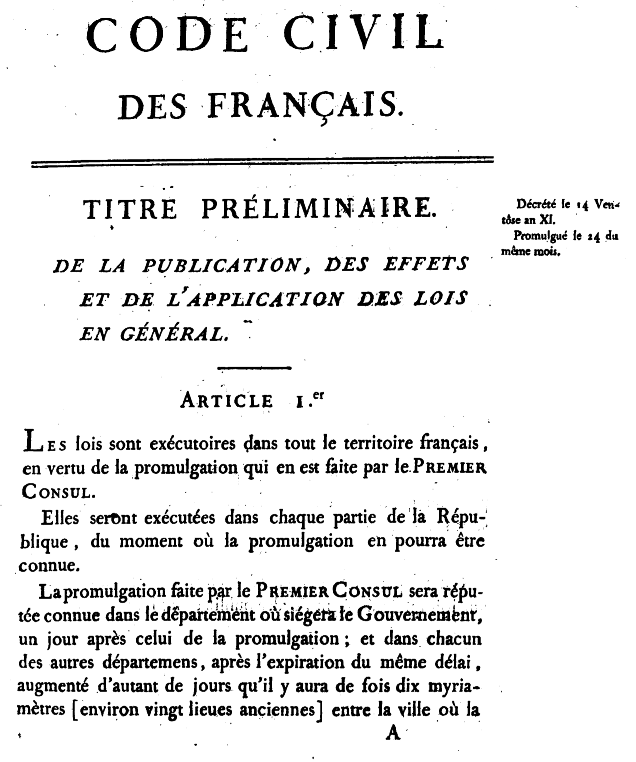
Background: The French Revolution of 1789 proclaimed "Liberty, Equality, Fraternity," but France's legal system remained a patchwork of over 300 different local codes. Northern France followed customary law, while the south adhered to Roman law traditions. Napoleon Bonaparte recognized that the Revolution's ideals needed to be codified into a single, accessible legal framework to truly transform French society.
What Happened: On March 21, 1804, the "Code civil des Français" — later known as the Napoleonic Code — was officially promulgated. Consisting of 2,281 articles, it enshrined equality before the law, the right to private property, religious tolerance, and freedom of contract. Napoleon personally attended 36 of the 57 commission meetings that drafted the code. Years later, exiled on Saint Helena, he declared: "My true glory is not the forty battles I won. What nothing will destroy, what will live eternally, is my Civil Code."
Significance: The Napoleonic Code was a revolutionary turning point in legal history. It spread across continental Europe through Napoleon's conquests and directly influenced the legal systems of Belgium, Italy, the Netherlands, Spain, much of Latin America, and even Japan. To this day, the basic structure of French civil law rests on this 222-year-old foundation. It remains the most influential legal code in modern history.
3. 1871 — Bismarck Becomes the First Chancellor of the German Empire

Background: Until the mid-19th century, there was no single nation called "Germany." Instead, 39 independent states formed the German Confederation, trapped in a power struggle between Austria and Prussia. Otto von Bismarck, appointed Minister President of Prussia in 1862, pursued German unification through his "Blood and Iron" policy — defeating Denmark (1864), Austria (1866), and France (1870-71) in rapid succession.
What Happened: After the German Empire was proclaimed at the Palace of Versailles on January 18, 1871, Bismarck was formally appointed as the first Imperial Chancellor (Reichskanzler) on March 21. Under a system where Prussian King Wilhelm I served as German Emperor, Bismarck wielded the real political power. He would dominate European politics for the next 19 years until his dismissal in 1890, orchestrating a complex web of alliances known as the "Bismarck System" that maintained the balance of power in Europe.
Significance: Bismarck's appointment fundamentally redrew the map of Europe. The emergence of a unified German Empire — with 41 million people and the continent's fastest-growing industrial economy — shattered the existing balance of power. The rivalries this created ultimately led to World War I. Known as the "Iron Chancellor," Bismarck remains one of the most consequential political figures in European history, a master tactician whose legacy still shapes the geopolitics of our world.
4. 1960 — The Sharpeville Massacre Exposes Apartheid's Brutality

Background: Since 1948, South Africa had enforced apartheid — a system of institutionalized racial segregation. Under the Pass Laws, Black South Africans were required to carry identification documents at all times; failure to produce them on demand meant immediate arrest. The Pan Africanist Congress (PAC) organized nationwide protests against these dehumanizing laws, calling on people to present themselves at police stations without their passes.
What Happened: On March 21, 1960, between 5,000 and 7,000 unarmed demonstrators gathered outside the Sharpeville police station in the Transvaal province. They were marching peacefully, demanding the abolition of the Pass Laws. At approximately 1:15 PM, police opened fire on the crowd without warning. The shooting lasted about two minutes. When the guns fell silent, 69 people lay dead and 180 were wounded. Many of the dead had been shot in the back while trying to flee. Women and children were among the victims.
Significance: The Sharpeville Massacre was the moment apartheid's true face was shown to the world. The United Nations initiated international sanctions against South Africa, and March 21 was later designated by the UN as the International Day for the Elimination of Racial Discrimination. Nelson Mandela's African National Congress (ANC) shifted to armed resistance, and Mandela himself went underground. It took 34 more years, but apartheid was finally dismantled in 1994 — and March 21 remains a public holiday in South Africa, known as Human Rights Day.
5. 1965 — Martin Luther King Jr. Leads the March from Selma to Montgomery

Background: Although the Civil Rights Act of 1964 had been passed, Black Americans in the Deep South were still systematically denied their right to vote. In Dallas County, Alabama, Black residents made up over half the population, yet only 2% were registered to vote. During voter registration protests in Selma, 26-year-old Jimmie Lee Jackson was shot and killed by a state trooper, igniting widespread outrage.
What Happened: On March 21, 1965, Martin Luther King Jr. led 3,200 marchers from Selma toward Montgomery, the Alabama state capital, on a 54-mile journey. This was the third attempt. The first march on March 7 — known as "Bloody Sunday" — ended when state troopers attacked marchers with tear gas and clubs on the Edmund Pettus Bridge. The horrific scenes, broadcast live on national television, shocked the nation. Protected by a federal court order and 2,000 Army soldiers and 1,900 National Guard members sent by President Lyndon B. Johnson, the third march finally succeeded. By the time they reached Montgomery on March 25, the crowd had swelled to 25,000.
Significance: The Selma to Montgomery march was one of the most pivotal moments in the American Civil Rights Movement. The images of Bloody Sunday galvanized public opinion, and President Johnson addressed Congress with the words "We shall overcome." Five months later, on August 6, 1965, the Voting Rights Act was signed into law, prohibiting racial discrimination in voting. This landmark legislation is considered one of the most important legislative achievements in American democracy, transforming the political landscape of the nation forever.
📌 History is a mirror reflecting today. Learning from past mistakes and drawing inspiration from great achievements — that's why we study history. What historical events await you tomorrow?
Comments
Post a Comment