583 Lives Lost in the Fog, the Day the Earth Shook for 4 Minutes — This Day in World History, March 27
In 1977, a wall of fog on Tenerife became the backdrop for aviation's deadliest disaster. In 1964, Alaska trembled for over four minutes under the most powerful earthquake ever recorded in North America. March 27 is a date etched with tragedy, innovation, and the echoes of human ambition.
🌍 Today in World History — TOP 5
1. The Tenerife Airport Disaster — Aviation's Darkest Hour (1977)

Background — On March 27, 1977, Los Rodeos Airport (now Tenerife North) on the Spanish Canary Islands was dangerously overcrowded. A bomb threat at nearby Gran Canaria Airport had diverted multiple jumbo jets to this small regional facility. Among them were KLM Flight 4805 (Boeing 747-206B) and Pan Am Flight 1736 (Boeing 747-121). To make matters worse, dense fog rolled across the airport, reducing visibility to under 300 meters.
What Happened — At 5:06 PM local time, the KLM aircraft began its takeoff roll without proper clearance. Captain Jacob Veldhuyzen van Zanten — ironically one of KLM's most experienced pilots and the face of its advertising — had confused a route clearance with takeoff authorization. The Pan Am jet was still taxiing on the same runway in the opposite direction. In the fog, neither crew could see the other. The KLM 747 slammed into the Pan Am aircraft at takeoff speed. All 248 people aboard the KLM flight perished, along with 335 of the 396 aboard the Pan Am flight. The death toll: 583. Only 61 passengers on the Pan Am side survived, many escaping through holes torn in the fuselage.
Significance — This remains the deadliest aviation accident in history. The disaster triggered a revolution in aviation safety. Airlines worldwide adopted Crew Resource Management (CRM) training, fundamentally changing cockpit communication culture. The word "takeoff" was restricted to actual clearance commands only. The 583 lives lost at Tenerife reshaped how every pilot and controller communicates — a tragic legacy that has saved countless lives since.
2. The Great Alaska Earthquake — North America's Most Powerful Quake (1964)

Background — Alaska sits at the collision zone of the Pacific and North American tectonic plates, making it one of the most seismically active regions on Earth. For roughly 500 years, stress had been building along a 970-kilometer fault line beneath Prince William Sound. On Good Friday, March 27, 1964, that accumulated energy was unleashed all at once.
What Happened — At 5:36 PM local time, a magnitude 9.2 megathrust earthquake struck Southcentral Alaska. The shaking lasted an astonishing 4 minutes and 38 seconds — an eternity by seismological standards. The fault ruptured along its entire 970 km length, displacing up to 18 meters. In Anchorage, soil liquefaction caused entire city blocks to collapse — Fourth Avenue dropped several meters in seconds. Tsunamis followed, reaching heights of 67 meters in Alaska's bays. The port town of Valdez was swept away by an underwater landslide. In the village of Chenega, 23 of its 68 residents died when an 8.2-meter tsunami hit. The final death toll reached 131, with damages totaling $311 million (roughly $2.9 billion in 2022 dollars).
Significance — The Good Friday earthquake was the second most powerful earthquake ever recorded globally (after Chile's 1960 quake). It provided crucial evidence supporting the theory of plate tectonics, which was still being debated at the time. The disaster led to major overhauls of seismic building codes across the United States and the expansion of the Pacific Tsunami Warning System. Parts of Kodiak Island were permanently uplifted by 9 meters — a staggering testament to the raw power of our planet.
3. The Naval Act of 1794 — Birth of the United States Navy
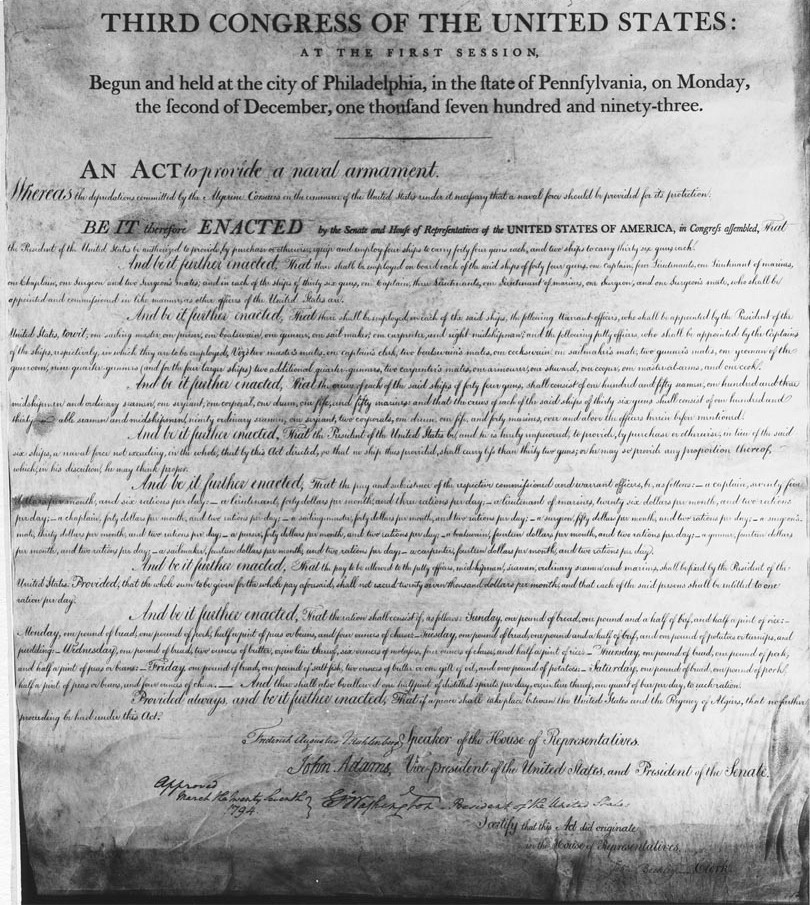
Background — After the American Revolution, the fledgling United States disbanded its Continental Navy and sold off every warship. It seemed like a cost-saving measure — until North African Barbary pirates began seizing American merchant ships in the Mediterranean, enslaving their crews, and demanding tribute payments. By the early 1790s, the situation was untenable. American sailors were being held captive, and the nation had no naval force to protect its commerce or project power.
What Happened — On March 27, 1794, the U.S. Congress passed the Naval Act of 1794, authorizing the construction of six frigates and establishing a permanent standing navy. The ships authorized — including the legendary USS Constitution, USS Constellation, and USS United States — were designed by Joshua Humphreys to be faster than ships of the line and more powerful than other frigates. The USS Constitution earned the nickname "Old Ironsides" after cannonballs appeared to bounce off her hull during the War of 1812.
Significance — Those six wooden frigates were the seed from which the world's most powerful navy grew. Today, the U.S. Navy operates 11 aircraft carriers, 74 nuclear submarines, and over 3,700 aircraft, with more than 324,000 active-duty personnel. What began as a defensive measure against pirates became the foundation of American global maritime dominance — a trajectory that the lawmakers of 1794 could scarcely have imagined.
4. FDA Approves Viagra — The Little Blue Pill That Changed Medicine (1998)
Background — In the early 1990s, British pharmaceutical giant Pfizer was conducting clinical trials on a compound called sildenafil, originally developed to treat angina (chest pain from heart disease). The drug showed disappointing results for its intended purpose. But researchers noticed an unexpected side effect: male participants reported significant improvements in erectile function. Pfizer made the pivotal decision to redirect the compound's development entirely.
What Happened — On March 27, 1998, the U.S. Food and Drug Administration approved sildenafil citrate under the brand name Viagra as the first oral treatment for erectile dysfunction. The response was explosive. Within its first year, Viagra generated over $1 billion in sales, becoming one of the fastest-selling pharmaceutical products in history. The iconic blue diamond-shaped pill became an instant cultural phenomenon, appearing in comedy sketches, news broadcasts, and dinner-table conversations worldwide.
Significance — Viagra did far more than treat a medical condition. It transformed how society discussed men's sexual health, shifting erectile dysfunction from a shameful secret to a treatable condition. The drug opened a massive market for sexual wellness pharmaceuticals and inspired competitors like Cialis and Levitra. Perhaps most importantly, Viagra stands as one of history's greatest examples of scientific serendipity — a failed heart drug that accidentally became a billion-dollar blockbuster and improved the quality of life for millions of men around the world.
5. Death of Yuri Gagarin — The First Human in Space Falls from the Sky (1968)
Background — Yuri Alekseyevich Gagarin (1934–1968) made history on April 12, 1961, when he orbited the Earth aboard Vostok 1, becoming the first human to travel to outer space. His famous words — "The Earth is blue" — became a defining quote of the Space Age. Gagarin was celebrated as a hero across the globe, receiving medals and honors from dozens of nations. After his historic flight, he continued working at the Yuri Gagarin Cosmonaut Training Center, mentoring the next generation of cosmonauts while preparing for his seventh space mission.
What Happened — On March 27, 1968, Gagarin took off in a MiG-15UTI training jet for a routine flight near Moscow. The aircraft suddenly entered a steep dive near the village of Novosyolovo and crashed, killing both Gagarin and his flight instructor, Vladimir Seryogin, instantly. He was just 34 years old. The cause of the crash remained classified for decades and spawned numerous theories — weather conditions, bird strike, pilot error, or another aircraft flying too close. A 2013 declassified report suggested that wake turbulence from a passing Su-15 fighter jet likely sent Gagarin's small trainer into an unrecoverable spin.
Significance — Gagarin's death shocked the Soviet Union and the world. His ashes were interred in the Kremlin Wall, and the cosmonaut training center was officially renamed in his honor. Though he lived only 34 years, Gagarin's legacy is immortal. He proved that humans could survive in space, opening the door to every mission that followed — from the Apollo moon landings to the International Space Station. The first person to see Earth from orbit left us far too soon, but his name will forever occupy the first page of humanity's greatest adventure.
📌 History is a mirror reflecting today. Learning from past mistakes and drawing inspiration from great achievements — that's why we study history. What historical events await you tomorrow?
Comments
Post a Comment